
The International Bureau of Weights and Measures (BIPM) recently conceded that Newton’s gravitational constant G was not as constant as expected: https://iopscience.iop.org/article/10.1088/1681-7575/ae570f
This was because they measured a G that was (6.67387 ± 0.00038) × 10⁻¹¹ m³ kg⁻¹ s⁻².
This was different from:
- most of the ones measured before
- the recommended range
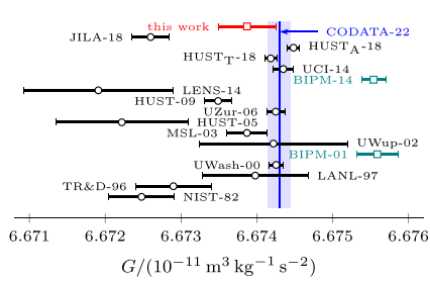
They conclude that there is new physics or some hidden effects.
This persistent scatter points to two possibilities: new physics or unrecognized instrumental effects.

We say that it points to Descartes’ Physics that creates hidden effects.
What Does Descartes’ Physics say?
Before Newton’s Physics became mainstream in the 1750’s, the accepted Physics was from Rene Descartes which:
- explained all phenomena
- united mind (psychology) and body (physics)
It was only thought to be disproven when Haley’s comet came, as predicted by Newton in 1758.
This was because:
- Descartes’ explanation for comets was for interstellar non orbital ones
- Newton’s explanation was for orbital comets stuck within our solar system
Proof of Descartes’ comet mechanics only came with Comet 3I/ATLAS which showed anomalies unexplainable by Newtonian Physics but are totally explainable by Descartes’ aether theory.

For example, the forward facing tail and bright light after leaving perihelion is clearly explained as refraction by the aether i.e. it’s just another form of gravitational lensing.
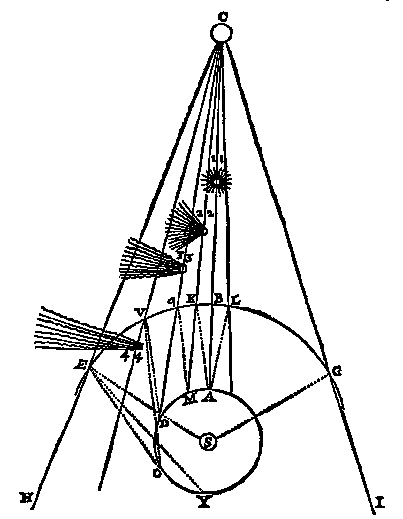
Atoms are Divisible
Descartes correctly said that atoms are divisible, a fact proven by particle collision in the large hadron collider:
The small parts of terrestrial bodies are not made up of atoms or indivisible particles. Rather, they are all made of the same matter [3rd Element]. Each one can be divided again in an infinite number of ways.

This is totally opposite of Newton’s wrong belief:
God in the Beginning formed Matter in solid, massy, hard, impenetrable, moveable Particles. No ordinary Power is able to divide what God himself made.
Atoms are made up of the 3rd Element, now called empty atomic space.
Like all Cartesian particles, the 3rd Element is always in motion, but not as active as the 2nd (dark matter) and 1st Elements (electromagnetism).
The physical air is made up of the 3rd Element. Its particles are less suited for motion than the 2nd Element.
This constant motion is now proven in the gluon field being in constant flux.
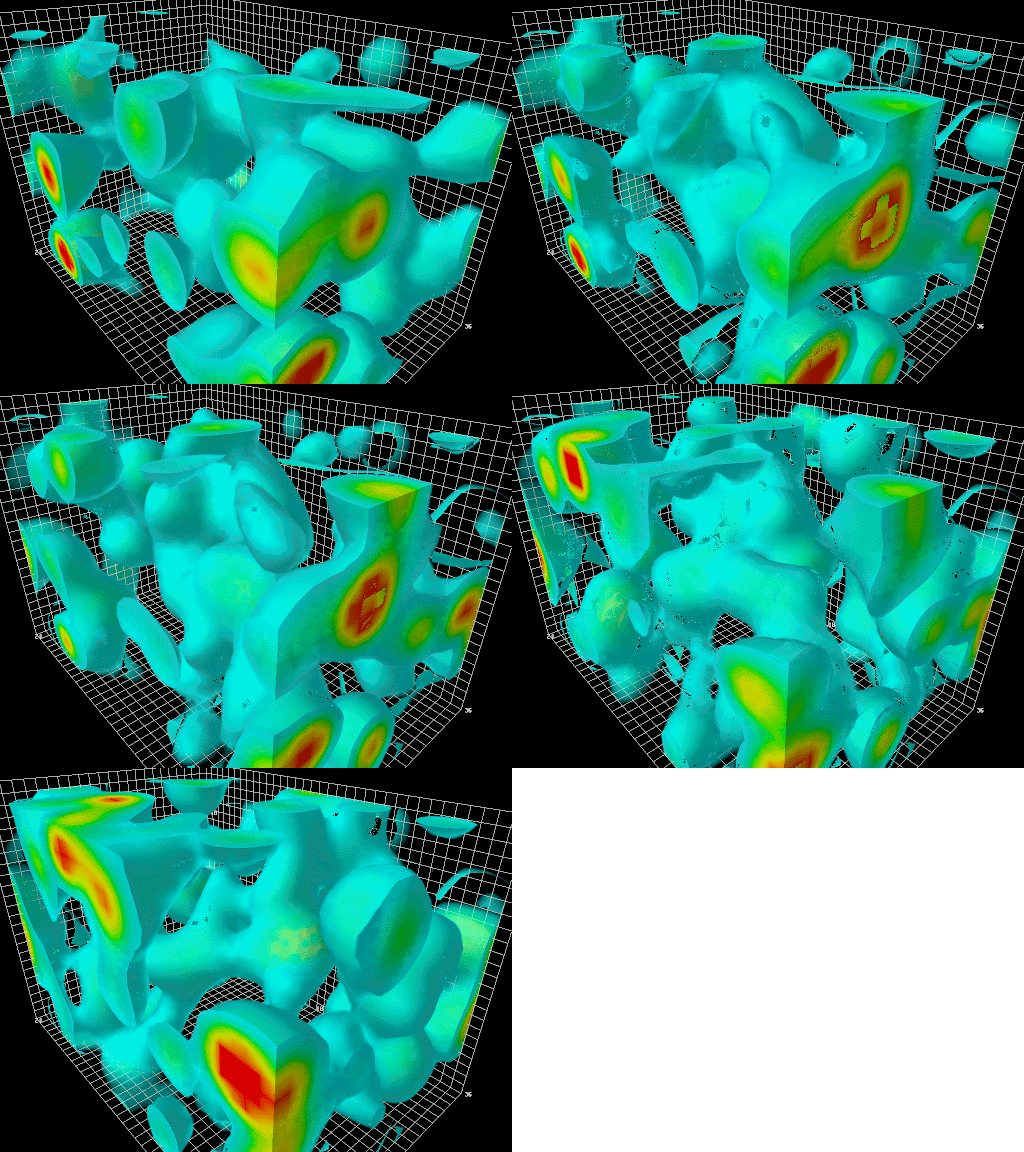
This constant flux changes the atomic space. This then causes the 2nd Element, called now as the aether as the vacuum of empty space, to vary.
The variation of the aether creates a varying G which is really from the displacement done by atomic space (matter particles) on the vacuum of space (space particles).
In other words:
- The atomic space and gluon field is inherently unstable – this leads to the probabilistic nature of particles
- The emtpy space reacts to this instability by going out of the atom in non-constant ways.
Leave a Comment
Thank you for your comment!
It will appear after review.