
Menu
Principles (click to expand)
Chapter 1 explained that the universe is made up of waves categorized into 5 layers.
Each wave moves up and down, as a result of the belligerence of the Positive and Negative Forces, from its zero level.
We call this zero or average level as the central signature or dharma for that wave.
This means that a wave has 3 kinds depending on its relation to that central signature. It can be:
- above that level – we call this the subtlifying influence (sattvaguna)
- within that level – we call this the transformative influence (rajoguna)
- below that level – we call this the crudifying influence (tamoguna)
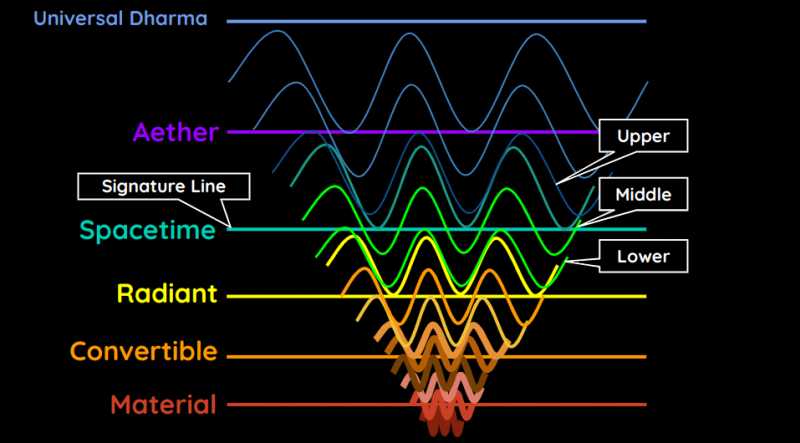
These 3 influences produce the 3 sublayers:
- upper
- middle
- lower
For example, the Material layer will have 3 sublayers with each with its own force or media, and quantum:
| Layer | Sublayer | Medium | Quantum |
|---|---|---|---|
| Aethereal | Upper | mom1 (gas, bose condensate) | qom1 (Up-Down Quarks) |
| . | Middle | mom2 (liquid) | qom2 (Strange-Down Quark) |
| . | Lower | mom3 (solid) | qom3 (Top-Bottom Quark) |
The Internal Boundary
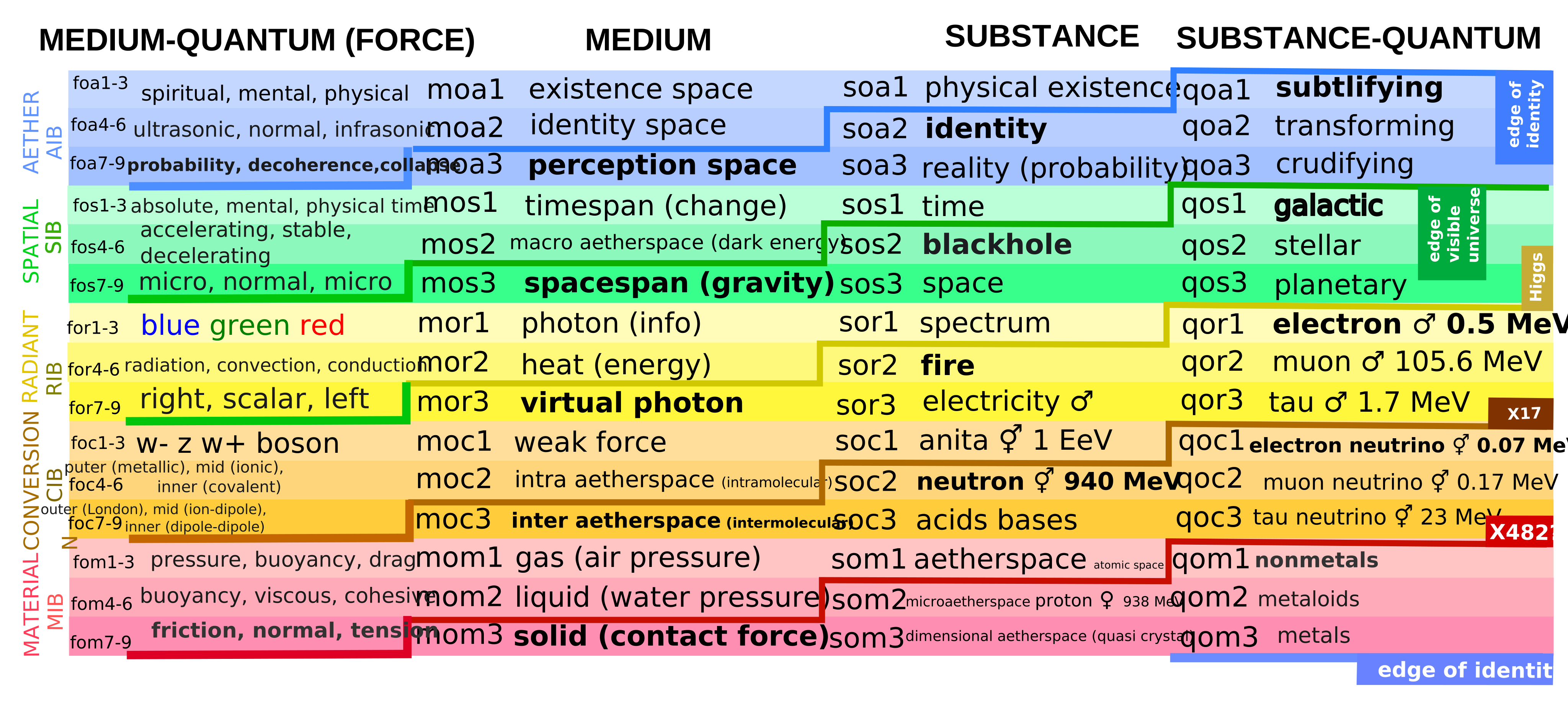
Within the sublayers is an internal boundary that separates the upper from the middle and lower sublayers.
- Above the boundary, the sublayer has more quasi-physical than physical properties.
- Below the boundary, the sublayer has more physical ones.
For example, a well known boundary is the Higgs Field which we regard as the internal boundary within the Radiant Layer.
- Below the Higgs Field, particles acquire measurable potential energy, called mass in Modern Physics, in Million electron Volts or MeV.
- Above the Higgs Field, particles such as photons and ‘gravitons’ have no mass. This is because particles above the boundary are kinetic instead of potential.
This gives us 5 Boundaries:
| Boundary | Physics Name | Description |
|---|---|---|
| Aethereal Internal Boundary (aib) | Edge of Identity | Separates aethereal identities that can be split up |
| Spatial Internal Boundary (sib) | Edge of Universe | Separates space from aetherspace |
| Radiant Internal Boundary (rib) | Higgs Field | Separates identities with potential energy |
| Convertible Internal Boundary (cib) | X17 | Separates left-hand-interacting identities |
| Material Internal Boundary (mib) | ? | Separates “protons” from “mesons” |
Leave a Comment
Thank you for your comment!
It will appear after review.