
Menu
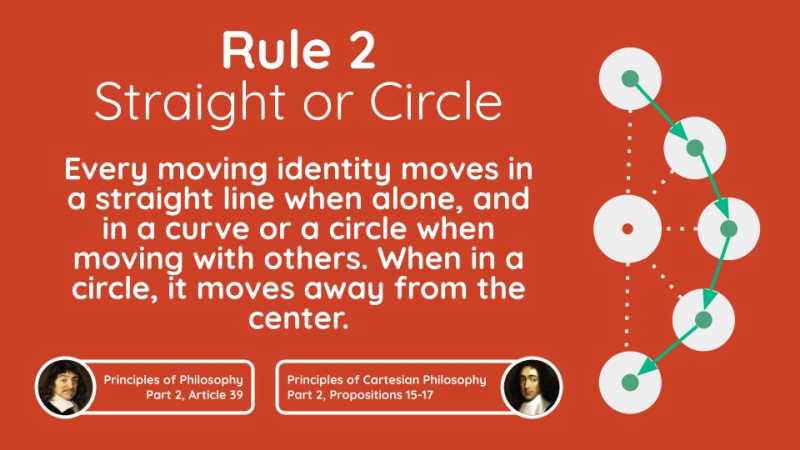
The 2nd Rule of Motion says:
Every moving identity moves in a straight line when alone, and in a curve or a circle when moving with others. When in a circle, it moves away from the center.
This is most obvious with surface tension such as bubbles forming spheres.
| Symbol | Meaning |
|---|---|
| centrifugal force — the outward pull an identity feels while moving in a circle | |
| mass — or metaphysically, “weight”/stake/commitment of the identity in the group | |
| radius — distance from the identity to the center it’s circling (a leader, an idea, a shared home) | |
| (Greek letter omega) angular velocity — how fast the identity is spinning/orbiting around that center | |
| omega squared — the spin rate multiplied by itself (this is why doubling the spin quadruples the outward pull) |
Equation Meaning: the outward pull equals mass times radius times the square of the spin rate — the faster something spins, or the farther out it sits, the harder it pulls away from center.
Leave a Comment
Thank you for your comment!
It will appear after review.