
Menu
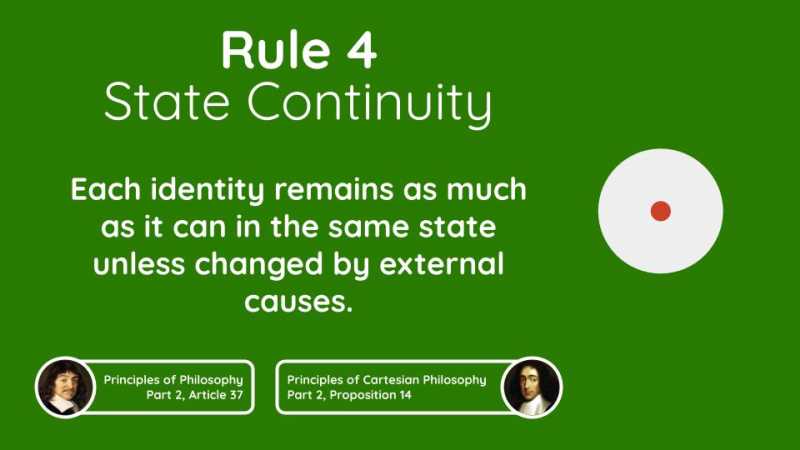
The 4th Rule is implemented by quantum mechanics.
| Symbol | Meaning |
|---|---|
| the resulting change in the identity’s state (velocity, opinion, behavior — whatever “state” means in context) | |
| the external force being applied (a push, a message, a policy, an influencer’s signal) | |
| mass — here read as resistance to change (inertia, stubbornness, cultural weight) | |
| this is just rearranged — the raw amount of change the force would cause with no resonance condition | |
| the frequency of the external force/influence (what “wavelength” the push is coming in on) | |
| the identity’s own natural frequency (what “wavelength” it normally resonates at) | |
| $ | \omega_F - \omega_i |
| (Greek letter epsilon) the identity’s tolerance for mismatch — how forgiving it is of an imperfect frequency match; small = rigid/hard to influence unless the match is near-perfect, large = open/easily influenced even by a loose match | |
| $\dfrac{\epsilon}{ | \omega_F-\omega_i |
Equation Meaning: the amount an identity actually changes equals the plain force-over-resistance amount, scaled down by how badly the influence’s frequency misses the identity’s own frequency — perfect match, full effect; way off, no effect; in between, partial effect.
Leave a Comment
Thank you for your comment!
It will appear after review.