
Menu
Chapter 1 introduced the idea of abstract particle shapes which are different from actual physical point particles.
These shapes come from the belligerence between the 2 Forces, the same principle that gives ‘shapes’ and ‘spin’ to ideas.
An idea can be:
- big or small
- powerful and viral, or weak and insignificant
Likewise, particles in the abstract can be:
- big or small
- have strong or weak spins
In the West, the concept of abstract shapes having physical effects was first known through Pythagoras. His ideas influenced Plato, leading to the Platonic solids.
In Asia, this concept is:
- in mandalas and yantras in Hinduism
- in i-ching and bagua and in Taoism

The Abstract Shapes of the 5 Elements
We apply the concept of abstract shapes to the quanta of the MSQ Model of the 5 Layers which was fully explained by Euclid in his book aptly called The Elements.
| Euclid | Topic | Layer |
|---|---|---|
| Book 1 | Triangles | Aethereal |
| Book 2 | Rectangles | Spatial |
| Book 3 | Circles | Radiant |
| Book 4 | Circles in Squares | Convertible |
| Book 5 | Ratios | Relationality |
| Book 6 | Numbers | Material |
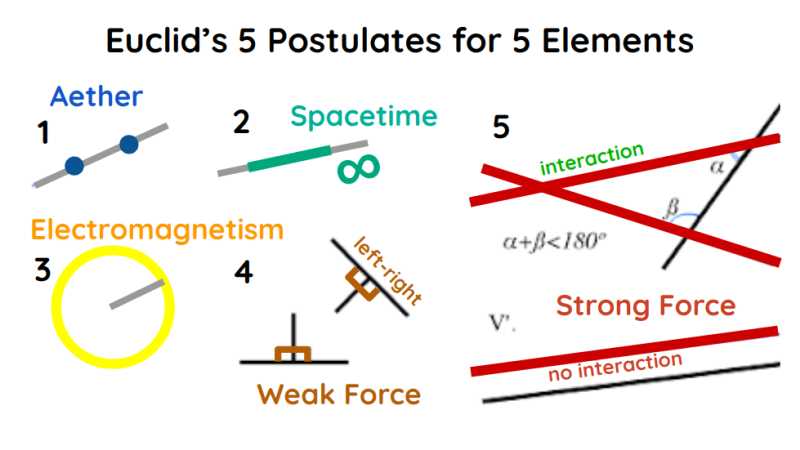
Shallow people judge with their eyes and thought that Euclid was explaining visual shapes.
- And so they think his book was about shapes.
In reality, he was talking about the dynamics of the 5 Elements. Kepler and Descartes did the same in an indirect way.
How it Works
The Euclidean Postulates can be suummed up in a few words:
- Point to Point
We interpret this as the aether particle.
- Infinite Line
We interpret this as the finite aetherspace that can extend indefintely.
- Circle
We interpret this as the “round” action of photons which are shaped as circle in a line.
- Right Angles
We interpret this as the left and right handed spin of the Weak Interaction
- Meeting at a Point
We interpret this as the triangle created by gluon flux tubes (3 aetherspace particles).
Particles are divided into force and nonforce.
- Force particles are bolts or screws
- Nonforce particles are nuts or washers
They are small columns, hollowed out with 3 spirals like screw-threads. This lets them pass through those narrow passages while twisting

Force particles drill through non-force particles which we can call receivers.
- Motion and spin comes from force particles that are transferred to receivers
These shape-based conceptions allow us to define quantal and substantial phenomena.
| Physics Name | Superphysics Version |
|---|---|
| Magnetic Moment | Size of Hole of Charged (or Gendered) Particle |
| Electrical Charge | Abundance or Lack of Receivers (when there could be receivers) |
| Male Charge | Abundance of Receiver |
| Female Charge | Lack of Receiver |
| Spin | Effort or Potential for Action |
| Electromagnetic Mass | Depth of Hole to use Virtual Photons |
| Material Mass | Aetherspace Strength |
| Female Terminal (Cathode) | Entrance of electrons (positive in Physics) |
| Male Terminal (Anode) | Exit of electrons (negative in Physics) |
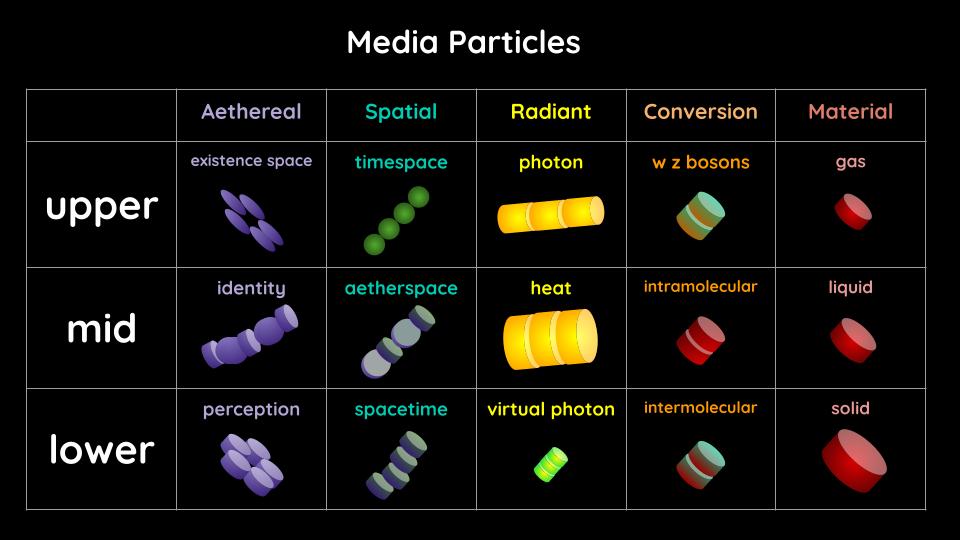
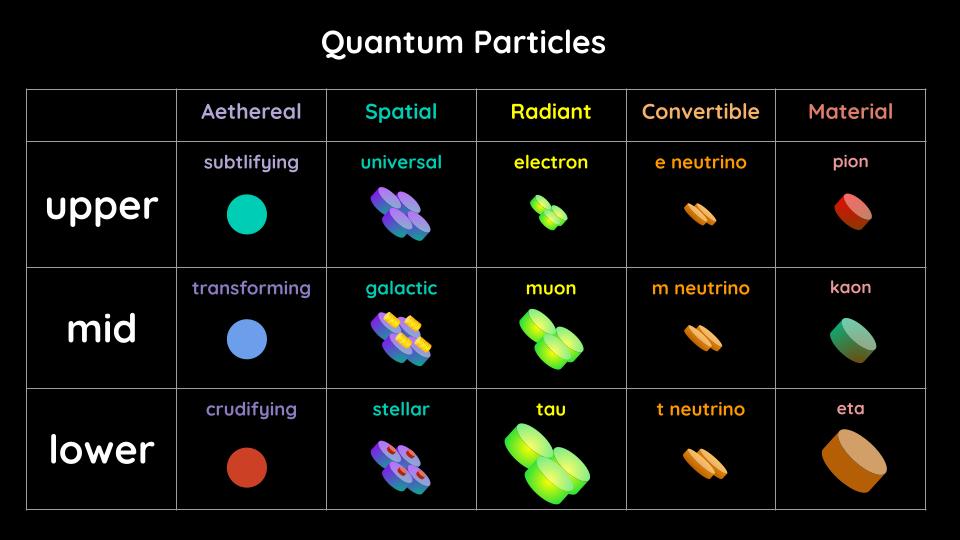
Particle Shapes Describe Particle Mechanics Better
This visualization will help us intuitively think of particle interactions.
Particle shapes remove the need for Feymann diagrams. This is because Feynman used action principles to trace paths in quantum mechanics.
But the problem is that particle paths are the effect of particle spin. So we use particle shapes to describe the spin that will necessarily lead to paths.
This is how meteorologists plot typhoon movement from their eye.
How We Got These
Sept 12, 2025
Leave a Comment
Thank you for your comment!
It will appear after review.